Engineering a Double-Wide 40-Foot Shipping Container
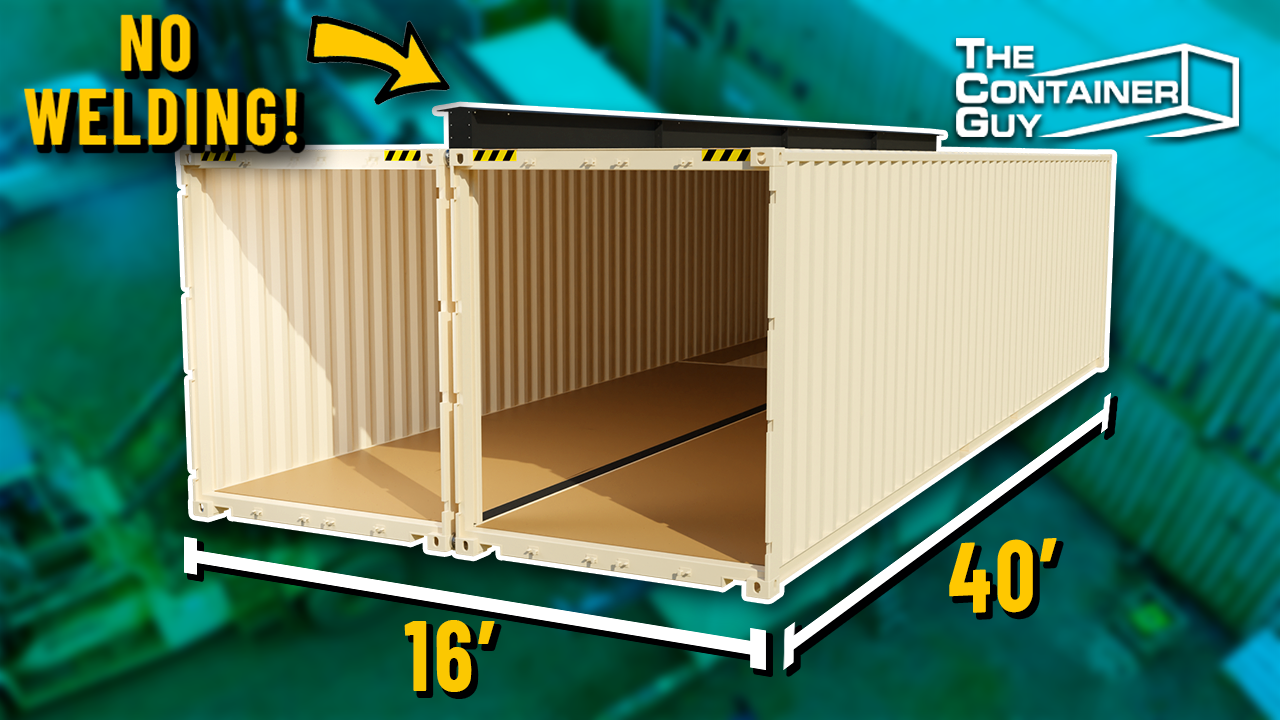
In this walkthrough, Channing McCorriston, The Container Guy, demonstrates how two 40-foot high cube shipping containers can be combined into a structurally engineered double-wide unit.
Built for a customer in Northern Alberta, this project shows how careful reinforcement, modular fabrication, and insulation strategies can transform standard containers into a durable 80-foot open-span structure.
The Objective
The goal was to remove the inner side walls of two 40-foot-high cube, one-time-use containers and join them to create a fully open interior space.
Removing structural walls creates several engineering challenges, particularly floor sag and roof load management. Addressing those issues properly is what separates a clean double-wide build from a compromised one.
Eliminating Floor Sag
When the side walls are removed, the container floor begins to sag because the bottom channel sits slightly elevated relative to the corner castings.
Testing revealed roughly half an inch of sag once the walls were cut out.
To correct this, a 0.5-inch-thick, 4-inch-wide flat bar was welded beneath the channel. This added stiffness and improved load distribution across the span. Temporary structural posts were also installed to support both roof and floor during transport and assembly.
This reinforcement ensures the finished double-wide remains structurally stable long-term.
Modular Bolt-Together Headers
A major feature of this system is the modular structural header design.
Headers were fabricated in manageable 10 to 12-foot sections, fully welded, sandblasted, and powder-coated with a textured black finish. Instead of welding them onsite, the system uses self-threading bolts that cut directly into 60 mm tubing.
This approach offers several advantages:
-
No onsite welding required
-
Reduced thermal bridging
-
Faster assembly
-
Simplified future repairs
The bolt-together system makes field installation more practical and repeatable.
Insulation and Snow Load Protection
Because the container will operate in Northern Alberta, snow load and insulation performance were critical.
The ceiling received 2 inches of spray foam insulation, creating a rigid slab that reinforces the roof while improving thermal efficiency. For residential-style container builds, 3 inches of spray foam on walls and ceiling is recommended.
Masking during spray foam application was carefully done to prevent overspray on structural brackets and connection points.
The double-wide configuration creates a continuous roof seam, so maintaining structural integrity and water resistance across that joint was a top priority.
Strut Lining and Electrical Setup
Before header installation, both containers were outfitted with wall and ceiling strut lining.
This system allows easy mounting of conduit, lighting, and future mechanical systems. LED lighting was installed using EMT conduit and wired so both containers operate from a single switch.
Strut lining adds modularity and flexibility for future customization.
Joining the Containers
Heavy-duty magnetic twist-lock bridge fittings connect the two containers at the corner castings. These fittings provide strong alignment and structural connection without welding.
Separate fittings are used for top and bottom corner castings, maintaining a consistent three-inch gap between containers for framing and flashing.
Once positioned on the foundation, either a concrete slab or steel beams, the containers are slid together and tightened. Ridge caps and end plates are installed to seal the roof and sides.
Temporary support posts are removed onsite, threshold flat bars are welded into place, and final electrical connections are completed.
Why This System Works
Creating a double-wide container requires solving structural weaknesses introduced by wall removal.
This system addresses those challenges through:
-
Floor reinforcement to prevent sag
-
Modular bolt-together headers
-
Heavy-duty bridge fittings
-
Spray foam insulation designed for harsh climates
-
Pre-engineered components for repeatable installation
The result is a full open clear span interior that significantly expands usable space compared to a single container.
Final Thoughts
Building a double-wide shipping container is more than cutting walls and sliding units together.
By reinforcing the floor, engineering modular headers, integrating insulation, and using precision bridge fittings, this project delivers a scalable and structurally sound solution.
It demonstrates how thoughtful engineering and modular design can turn two standard containers into a durable, expanded structure built to handle demanding environments.