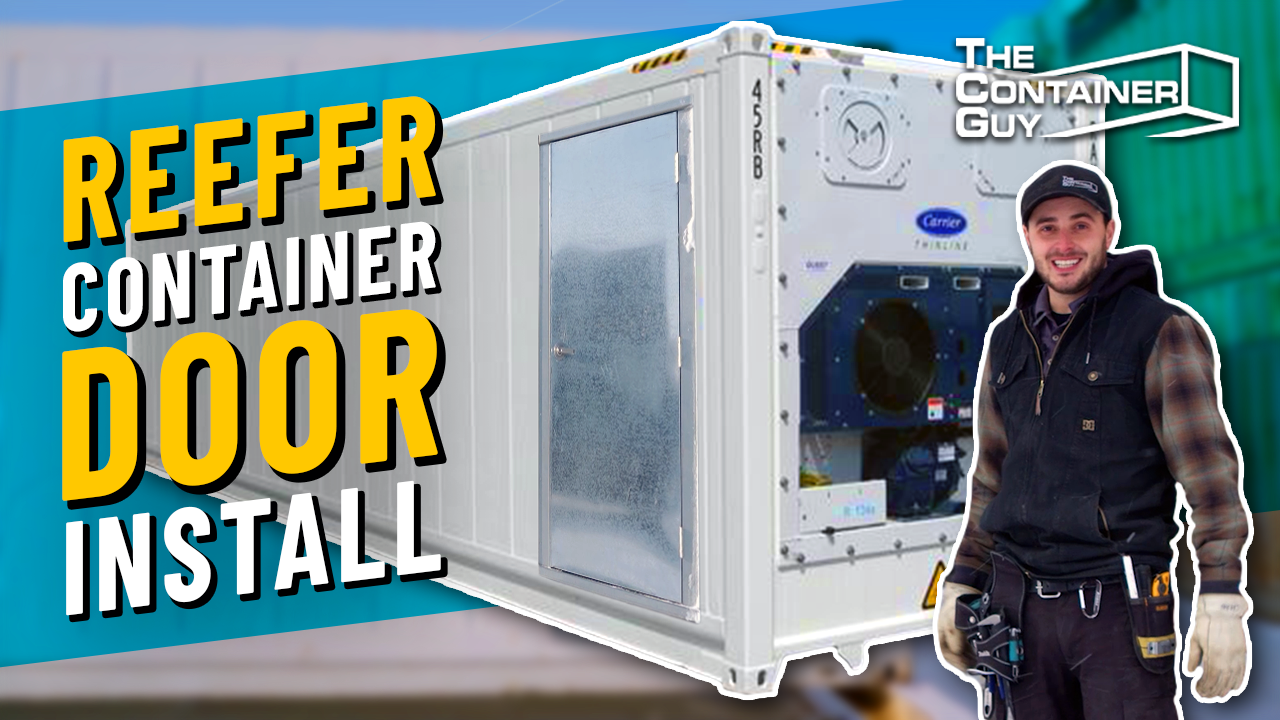
Installing a Man Door on a 40-Foot Refrigerated Shipping Container
In this walkthrough, Channing McCorriston, The Container Guy, explains the process of installing a man door on the side of a 40-foot refrigerated shipping container, also known as a reefer.
Unlike standard dry containers, reefers present unique structural and insulation challenges. Proper measurement, cutting, and sealing are critical to maintaining the container’s thermal performance and structural integrity.
Understanding the Differences in Refrigerated Containers
Refrigerated containers differ significantly from standard shipping containers.
The refrigeration unit is inset into the container, which means the man door installation sits approximately 18 inches back from the end wall. The floor system is also deeper than in standard containers, requiring careful measurement to avoid cutting the opening too low.
The walls consist of two stainless steel panels sandwiching roughly three inches of closed-cell foam insulation. This creates an insulated panel similar to a structural insulated panel, delivering an approximate R20 thermal rating.
Because of this insulated construction, cutting into a reefer requires extra precision.
Measuring and Marking the Opening
The process begins with careful measurement and marking.
A drill is used to create reference holes through the wall, allowing alignment between the interior and exterior surfaces. This ensures the rough opening is properly positioned relative to the floor and structural elements.
The man door includes a four-inch flange, so the cut must follow the inside edge of the container corrugation to create a flat surface for mounting.
Accurate layout is essential to prevent misalignment or fitment issues.
Cutting Through Steel and Insulation
Cutting a reefer wall involves multiple layers.
Tools used include:
-
A sawzall for cutting steel corners
-
An angle grinder for trimming
-
A cutting tool to remove interior plywood floor sections
Once the stainless steel skin is cut, the closed-cell foam core must be carefully managed without damaging surrounding areas.
The goal is to preserve as much structural integrity and insulation as possible while creating a clean opening.
Preparing the Door for Installation
To avoid working with small hardware components in extreme cold, the door handle was pre-installed indoors.
This small step saves significant time and frustration in harsh conditions. Cold weather affects tools, seals, and even pens, so preparation becomes even more important.
A bulb seal was installed along the top header of the door frame to help accommodate minor gaps and ensure a tight weather seal against the container’s corrugated surface.
Installing Without Welding
Instead of welding the door frame into place, the installation uses drilling and riveting.
Riveting offers several advantages:
-
Faster installation
-
No paint damage
-
Reduced risk of corrosion
-
No need for grinding or repainting
This approach preserves the container’s exterior finish and avoids introducing heat that could compromise insulation.
Once the door frame is riveted, spray foam is applied to the gap between the door frame and the container wall. Interior flashing is then installed to cover exposed edges and provide a clean finish.
Cold Weather Challenges
This installation took place in extreme cold, including temperatures approaching minus 40 degrees Celsius.
Cold conditions significantly slow the process. Materials become brittle, seals stiffen, and tools lose efficiency. What would normally be a one-hour installation extended into multiple days due to weather constraints.
Planning around environmental conditions is essential when modifying containers outdoors in winter climates.
Why Proper Sealing Matters
Refrigerated containers are designed for thermal performance. Cutting into the wall compromises that envelope if not handled correctly.
By:
-
Accurately measuring the opening
-
Using mechanical fastening instead of welding
-
Applying bulb seals and spray foam
-
Installing interior flashing
the thermal integrity of the container is largely maintained.
Final Thoughts
Installing a man door on a refrigerated container requires more precision than modifying a standard shipping container.
Understanding the inset refrigeration unit, deeper floor system, and insulated wall construction is critical before cutting begins. With proper planning, careful measurement, and clean mechanical fastening, a man door can be added while preserving insulation performance and structural stability.
This project highlights the importance of preparation, accuracy, and adaptability, especially when working in extreme weather conditions.